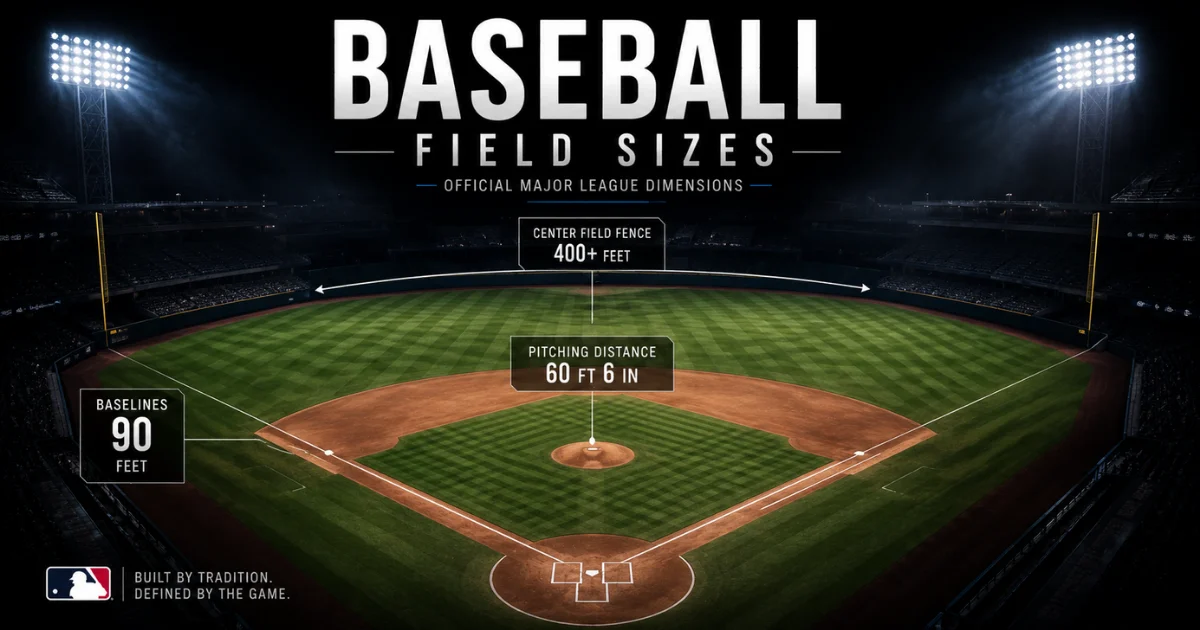
The standard MLB baseball field uses 90-foot baselines, a 60-foot 6-inch pitching distance, and a center field fence at least 400 feet from home plate. But that’s just the beginning. From Tee Ball diamonds to professional stadiums, each level has precise specs that affect everything from player safety to field construction.
Baseball Field Sizes Dimensions Chart
Keep this chart handy for field construction, league compliance, coaching prep, or facility planning.
Baseball Field Dimensions Chart
| Level | Baseline | Home → 2nd | Pitching Distance | LF / RF Min. | CF Min. |
|---|---|---|---|---|---|
| Tee Ball (ages 4–7) | 50 ft | 70 ft 8 in | N/A | 125 ft | 200 ft |
| Little League Minor / Major (ages 9–12) | 60 ft | 84 ft 10¼ in | 46 ft | 175 ft | 225 ft+ |
| LL Intermediate 50/70 (ages 11–13) | 70–90 ft | varies | 50–60 ft 6 in | 200 ft+ | 200 ft+ |
| LL Junior League (ages 12–14) | 90 ft | 127 ft 3⅜ in | 60 ft 6 in | 300 ft+ | 300 ft+ |
| LL Senior League (ages 13–16) | 90 ft | 127 ft 3⅜ in | 60 ft 6 in | 300 ft+ | 300 ft+ |
| PONY Bronco (ages 9–12) | 70 ft | 99 ft | 50 ft | 225 ft | 275 ft+ |
| PONY Pony League (ages 11–14) | 80 ft | 113 ft 2 in | 54 ft | 265 ft | 315 ft+ |
| Middle School – 7th Grade | 70 ft | 99 ft | 50 ft | — | 200 ft |
| Middle School – 8th Grade | 80 ft | 113 ft 2 in | 54 ft | — | 300 ft |
| High School (NFHS) | 90 ft | 127 ft 3⅜ in | 60 ft 6 in | 300 ft | 400 ft+ |
| College / NCAA | 90 ft | 127 ft 3⅜ in | 60 ft 6 in | 330 ft | 400 ft+ |
| MLB | 90 ft | 127 ft 3⅜ in | 60 ft 6 in | 320 ft+ | 400 ft+ |
More Post: Can Koozie Sizes: Heights & Print Specs
Standard Baseball Field Dimensions by Level
Not all baseball fields are the same. Each level has a specific purpose, a specific age group, and specific numbers that matter for fair play and player development.
MLB Baseball Field Dimensions (The Standard)
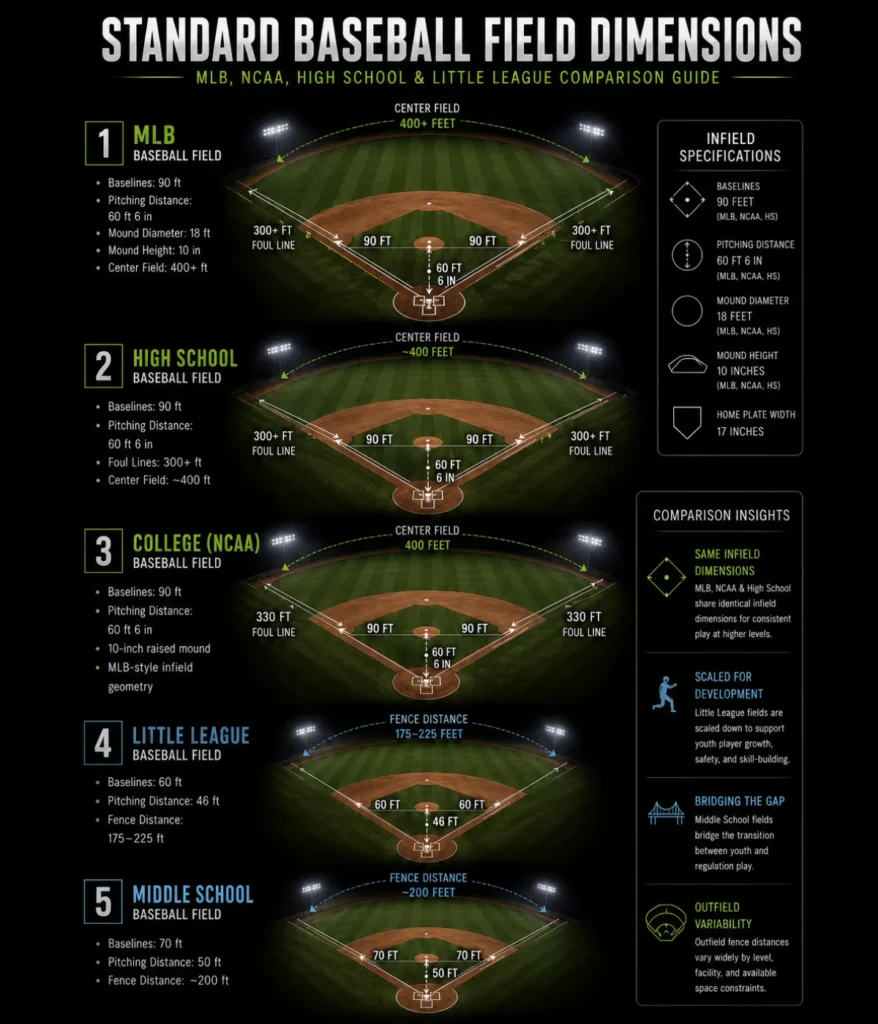
The baseline measures exactly 90 feet. The pitching distance is 60 feet 6 inches. The pitcher’s mound is an 18-foot diameter circle raised 10 inches above home plate. Center field sits at 400 feet or more from home plate.
These infield dimensions have been consistent since 1893 when MLB set the 60’6″ pitching distance. That consistency allows universal compatibility across all 30 MLB stadiums for equipment, player positioning, and gameplay rules.
High School Baseball Field Dimensions (NFHS)
A high school field uses 90-foot baselines and a 60-foot 6-inch pitching distance — identical to MLB on the infield. The outfield fence must sit at least 300 feet down both foul lines and approximately 400 feet to center field.
Many high school parks fall short of the 400-foot center field standard due to land constraints. When that happens, leagues document the actual distances as local ground rules. The infield specs, however, are non-negotiable at the high school level.
College Baseball Field Dimensions (NCAA)
NCAA college fields match the MLB and high school infield exactly: 90-foot baselines, 60 ft 6 in pitching distance, and a mound raised 10 inches above home plate.
The outfield requirement is slightly stricter than high school. NCAA mandates a minimum of 330 feet down each foul line — 30 feet more than the high school minimum — and 400 feet recommended to center field.
Little League Baseball Field Dimensions
Little League is the world’s largest youth baseball organization, operating in more than 80 countries. Its field dimensions are built around what players can physically do at each age group.
The Major Division (ages 9–12) — the most recognized Little League setup — uses 60-foot baselines and a 46-foot pitching distance. The outfield fence is recommended at a minimum of 175 feet down the lines and 225 feet to center field.
The Senior League (ages 13–16) steps up to a full 90-foot diamond and 60 ft 6 in pitching distance — the same specs used at the high school, college, and professional levels.
Middle School Baseball Field Dimensions
Middle school dimensions sit between Little League and full-size play — a level most guides skip entirely.
7th grade players use a 70-foot diamond and a 50-foot pitching distance. The outfield back fence sits around 200 feet from home plate.
8th grade players move to an 80-foot diamond with a 54-foot pitching distance. The outfield steps up to approximately 300 feet — matching the lower end of high school outfield minimums.
PONY League Baseball Field Dimensions
PONY Baseball (Protect Our Nation’s Youth) runs its own separate youth league system with a different step-up model than Little League. PONY uses 70-foot and 80-foot baselines as gradual bridges to full-size play — transitions Little League skips.
PONY League Baseball Field Dimensions
| PONY Division | Age Group | Baseline | Pitching Distance | CF Min. |
|---|---|---|---|---|
| Shetland / Foal | 3–6 | 50 ft | 38 ft | 200 ft+ |
| Pinto | 5–8 | 50 ft | 38 ft | 200 ft+ |
| Mustang | 7–10 | 60 ft | 46 ft | 225 ft+ |
| Bronco | 9–12 | 70 ft | 50 ft | 275 ft+ |
| Pony | 11–14 | 80 ft | 54 ft | 315 ft+ |
| Colt / Palomino | 13–18 | 90 ft | 60 ft 6 in | 350 ft+ |
Baseball Field Distances & Measurements Explained
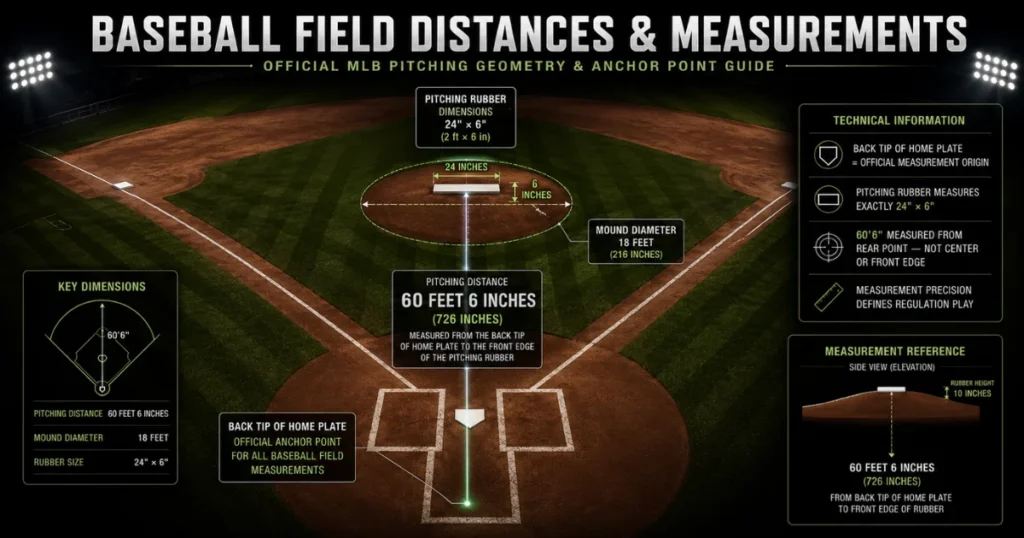
Home plate to second base is the key diagonal measurement used to verify a true square. On a 90-foot diamond, that distance is 127 feet 3⅜ inches. If you measure both diagonals — home-to-second and first-to-third — and they don’t match exactly, your diamond is skewed.
The pitching rubber is a white rectangle measuring 24 inches × 6 inches. It sits exactly 60 feet 6 inches from the back tip of home plate — not the front edge, not the center. The back tip is always the anchor point for all field measurements.
The bases each measure 18 inches on all sides at the MLB level, increased from 15 inches in September 2022 to reduce collision risk between base runners and fielders.
Baseball Field Dimensions vs. Softball Field Dimensions
Baseball and softball fields look similar. They are very different in practice.
Baseball Field Dimensions vs. Softball Field Dimensions
| Spec | Baseball (HS / College / Pro) | Fastpitch Softball (NCAA) | Slowpitch Softball |
|---|---|---|---|
| Baseline | 90 ft | 60 ft | 65 ft |
| Pitching Distance | 60 ft 6 in | 43 ft (NCAA) / 40 ft (HS) | 50 ft |
| Mound Type | Raised 10 inches | Flat circle (8 ft diameter) | Flat circle |
| Home → 2nd | 127 ft 3⅜ in | 84 ft 10¼ in | 91 ft 11 in |
| CF Fence Min. | 400 ft+ | 190–235 ft | 275 ft+ |
| Batter’s Box | 4 ft × 6 ft | 3 ft × 7 ft | 3 ft × 7 ft |
Height comparison: A softball pitching distance of 43 feet is nearly 18 feet shorter than a baseball pitching distance of 60’6″. That gap directly affects reaction time — a 70 mph fastpitch softball pitch reaches the plate in approximately the same reaction-time window as a 95 mph baseball pitch.
Question’s
What are the standard dimensions of a baseball field?
The standard MLB baseball field uses 90-foot baselines, a 60-foot 6-inch pitching distance, and a center field fence at 400 feet or more from home plate.
How big is a Little League baseball field?
A Little League Major Division field (ages 9–12) uses 60-foot baselines and a 46-foot pitching distance. The outfield fence is recommended at a minimum of 175 feet down the foul lines and 225 feet to center field.
What is the distance between bases in baseball?
In MLB, college, and high school, bases are 90 feet apart. Youth leagues scale down: Little League uses 60 feet, PONY Bronco uses 70 feet, PONY Pony League uses 80 feet, and Tee Ball / Pinto divisions use 50 feet.
Why is the pitcher’s mound 60 feet 6 inches from home plate?
MLB officially adopted the 60-foot 6-inch pitching distance in 1893 to restore competitive balance between increasingly powerful pitchers and hitters.
How far is home plate to second base?
On a regulation 90-foot diamond, home plate to second base measures 127 feet 3⅜ inches. This diagonal is the key check measurement for a true square.
How big is a high school baseball field?
A high school field (NFHS) uses 90-foot baselines and a 60-foot 6-inch pitching distance — identical to MLB on the infield. Outfield fences must be at least 300 feet down each foul line and approximately 400 feet to center field.
What is the pitcher’s mound height in baseball?
The pitcher’s mound is raised 10 inches above home plate level at the MLB, college, and high school levels. The mound itself is an 18-foot diameter circle of raised dirt.
What is the warning track on a baseball field?
The warning track is a contrasting surface strip running inside the outfield fence. It is typically made of crushed gravel, brick dust, or rubberized material.
Do baseball field dimensions vary by brand or organization?
The infield dimensions do not vary. They follow standardized specs set by Little League International, PONY Baseball, NFHS, NCAA, and MLB. Outfield fence distances vary — especially at the MLB level, where each ballpark sets its own distances.
Are baseball field dimensions the same internationally?
Not exactly. While MLB-style fields in the Dominican Republic, Japan (NPB), and South Korea (KBO) use the same 90-foot baseline and 60’6″ pitching distance for professional play, amateur and youth leagues in those countries may follow local federation standards.

Sara Khan is the admin of Suitcases Size. She manages website content, reviews measurement guides, and ensures readers get simple, accurate, and easy-to-understand information about sizes, dimensions, and travel measurements.